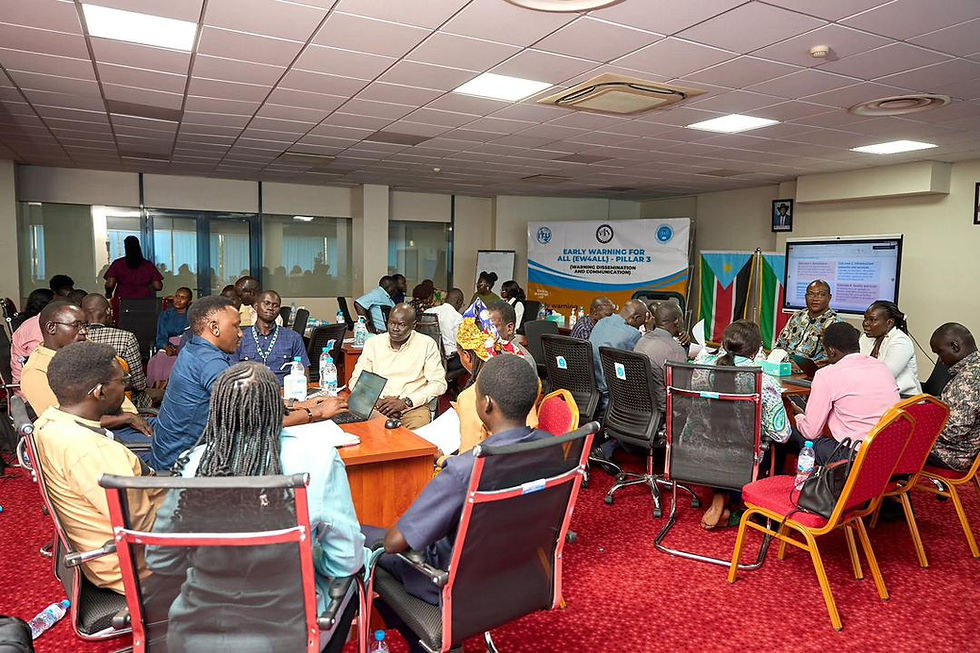
Participants engage in a collaborative session during the EW4ALL group discussion, focusing on improving early warning systems for enhanced communication and preparedness. The Early Warning for All-EW4ALL initiative led by the International Telecommunication Union-ITU is a global effort to ensure that every person is protected by timely and effective early warning systems. In a country like South Sudan where most communities are increasingly vulnerable to floods, droughts and other hazards, access to timely information can mean the difference between safety and disaster. As the focal point for Pillar 3: Warning Dissemination and Communication, the National Communication Authority-NCA plays a central role in ensuring that early warnings are not only generated but effectively delivered to the people who need them most. To solidify this roadmap, NCA recently held a national consultative workshop bringing together various partners and stakeholders to have an in-depth discussion addressing the technical and logistical ways of reaching the population. This collaborative forum ensured that the strategies for Pillar 3 are grounded in the collective expertise of all involved partners. At the core of Pillar 3 is the use of modern communication technologies to deliver alerts quickly and reliably. Mobile networks are being strengthened to act as lifelines during emergencies with tools such as Cell Broadcast and SMS to send alerts directly to individuals even during times of network congestion. These systems are reinforced through a multi-channel communication approach that combines radio, television, social media and community-based platforms to maximize reach and reliability. In addition, the adoption of the Common Alerting Protocol-CAP enables standardized alerts to be disseminated simultaneously across different platforms ensuring consistency, clarity and trust in critical moments. However, effective warning dissemination goes beyond simply sending alerts. This pillar also places strong emphasis on last-mile connectivity which ensures that warnings are not only received but also understood and acted upon by all communities especially those in remote and underserved areas. This includes translating messages into local languages to enable accessibility for persons with disabilities and integrating traditional communication methods with modern systems. By combining innovation with inclusivity, South Sudan is working to ensure that no one is left behind when disaster risks arise. Equally important is the need for two-way communication and continuous improvement. Early warning systems must not only inform but also listen. Through feedback mechanisms such as community engagement platforms and satisfaction surveys, authorities can assess whether warnings are timely, relevant and effective. This feedback loop is essential for building trust and refining communication strategies over time. Strategic investments are already underway to support this vision as the national roadmap outlines a comprehensive plan to equip Emergency Operation Centers (EOCs) across the country with modern technology including sophisticated computers, communication tools and skilled personnel. This includes a projected $2.8 million investment to strengthen EOC capacity at the state and county levels, alongside the establishment of an Authorized Alerting Team to coordinate timely warnings across all relevant responders. Through the leadership of the National Communication Authority in collaboration with the Ministry of Information, Communication Technology and Postal Services (MICTPS) and the Relief and Rehabilitation Commission-RRC, South Sudan is steadily advancing toward a future where timely information bridges the gap between hazards and a safe, prepared population.